
The India release of the Oscar-nominated film 'The Voice of Hind Rajab', based on the story of a five-year-old Palestinian girl killed by Israeli forces, is facing delays as the distributor awaits a censor certificate.

The ongoing conflict involving the United States, Israel, and Iran intensified sharply with attacks on critical energy infrastructure across the Gulf, even as US President Donald Trump said he had cautioned Israeli Prime Minister Benjamin Netanyahu against targeting Iran's key South Pars Gas Field.
Following a joint attack by the US and Israel on Iran, India is calling for restraint and de-escalation to avoid further military confrontation in the Middle East.

Despite decades of efforts towards energy transition, oil will remain the critical energy source for all nations for some decades. We can hope for peace opening the Strait of Hormuz, but must prepare for war closing it, points out former foreign secretary Ranjan Mathai.

Indian benchmark indices Sensex and Nifty rebounded in early trade, tracking a recovery in global equity markets and an easing of hostilities between Israel and Iran, after a sharp fall in the previous session.

Young Indian shuttler Rounak Chouhan continued his impressive run at the US Open badminton tournament, defeating Misha Zilberman to reach his first BWF World Tour Super 300 semifinal. Devika Sihag also advanced by upsetting third seed Riko Gunji, and former world No. 1 Kidambi Srikanth secured his spot in the semifinals, raising hopes for an all-India final.

Pakistani Prime Minister Shehbaz Sharif is actively engaged in diplomatic efforts to de-escalate tensions in West Asia, offering to host talks between the US and Iran and engaging with regional leaders to promote peace and stability.

The arms trade surplus grew tenfold, reaching $691 million in FY26 from $63 million in FY18.

India and Israel have strongly condemned terrorism in all its forms, including cross-border terrorism, and reaffirmed their commitment to combating the threat.

The United States on Saturday (local time) launched a third round of strikes against Iran after alleging that Iran's Islamic Revolutionary Guard Corps (IRGC) attacked the Cyprus-flagged container vessel M/V GFS Galaxy in the Strait of Hormuz.

Trump's phone calls with Netanyahu came after Iran threatened to end the negotiations with the US over Israel's attacks on Lebanon. Netanyahu had said Israel would hit "terror targets" in Beirut if Hezbollah did not stop attacking Israel.

The Israeli Air Force has destroyed an aircraft used by Iranian leadership at Mehrabad International Airport in Tehran, along with striking over 200 targets across western and central Iran, significantly impacting Iran's strategic capabilities.
Indian benchmark equity indices Sensex and Nifty closed higher, recovering from previous losses, driven by a global market rebound, a pause in Israel-Iran hostilities, and a rally in bank stocks.

Israel has for more than two decades and several US presidencies worked to draw the United States into a full-scale war with Iran. Having finally achieved that, the last thing it wants is Trump declaring victory and going home, as he is prone to do. Ali Larijani was the figure most capable of handing Trump a negotiated exit with something to show for it. Without Larijani, the road to an exit gets considerably narrower. Prem Panicker continues his must read daily blog on the Gulf War.

By appearing to privilege ideological affinity over strategic balance, India risks eroding the trust painstakingly built across West Asia. Once the perception takes hold that India's friendship is conditional and transactional, rebuilding credibility will be difficult, warns Amberish K Diwanji.

Indian wedding bookings to Sri Lanka are projected to grow 20-25 per cent annually over the next few years.

A joint attack by the United States and Israel on Iran has triggered a massive military confrontation in the Middle-East.

The harsh truth is that the US is no longer a reliable partner, cautions Ramesh Menon.

For years, these two powers operated as "frenemies" in the shadow of Iran's regional influence. The frame here is "The Enemy of My Enemy."

Iran's Persian Gulf Strait Authority (PGSA) has declared the Strait of Hormuz closed due to 'recent illegal movements' by the US military, demanding transit permits, while the US Central Command (CENTCOM) insists the strait is 'open to all vessels' and vows to ensure 'freedom of navigation'.

Prime Minister Narendra Modi will visit Israel to enhance defence and trade cooperation amid Middle East tensions. Discussions will include defence, security, and the situation in Gaza.

Three Indian-flagged crude oil tankers, Desh Vaibhav, Desh Vibhor, and Sanmar Herald, successfully transited the Strait of Hormuz and are en route to India, even as Iran announced the closure of the critical waterway following Israeli strikes in Lebanon.

Donald Trump asked countries involved in the peace talks with Iran to sign on to the Abraham Accords, which deal with establishing diplomatic, economic and security ties between Israel and Arab nations.

Pakistan Prime Minister Shehbaz Sharif clarified that the recent Memorandum of Understanding (MoU) signed between the US and Iran does not include provisions regarding Tehran's ballistic missile programme. This statement followed talks with Iranian President Masoud Pezeshkian, with Sharif emphasising Iran's right to its defence capabilities and Pakistan's role as a mediator in the US-Iran peace process.
To be sure, Trump is furious, as the trajectory of the war is in a state of Zugzwang, as chess players call it. Trump and Netanyahu stare at two choices -- retreat in humiliation and concede Tehran's demands -- recognition of its rights, reparations, and binding security guarantees -- or perish in a quagmire, points out Ambassador M K Bhadrakumar.

External Affairs Minister S Jaishankar has affirmed India's commitment to ensuring issues like a free, open, and rule-based maritime order, seafarer safety, and countering terror financing receive due attention at the UN Security Council during its 2028-29 term.

US Special Envoy Steve Witkoff and Iranian Foreign Minister Abbas Araghchi are reportedly heading to Switzerland for a new round of US-Iran negotiations, following a recently announced memorandum of understanding to end hostilities in West Asia and a ceasefire between Israel and Hezbollah.

The US and Iran have agreed on a roadmap aimed at reaching a final agreement within 60 days after hours-long talks at the Swiss resort of Burgenstock, mediators Qatar and Pakistan said on Monday, describing the progress as "encouraging."
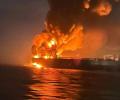
An oil tanker carrying 24 Indian seafarers reported a fire off the coast of Oman, with all crew members confirmed safe. The incident occurred amidst renewed hostilities between Israel and Iran, who exchanged attacks on petrochemical facilities.

Addressing the Israeli Parliament, the Knesset, Modi offered his deepest condolences to the people of Israel for every life lost in the terrorist attack by Hamas on October 7, 2023.

The Congress party has alleged that convicted sex offender Jeffrey Epstein played a role in shaping the India-Israel relationship after 2014, citing email exchanges made public under the 'Epstein Files'.

Indian benchmark indices Sensex and Nifty experienced a significant slump in early trade, mirroring a sharp decline in global equities and a fresh spike in crude oil prices, exacerbated by simmering tensions in West Asia and a global unwinding of the AI-led rally. Track how sensex, Nifty fared on June 8.

'To suddenly give the impression of taking a position that is hostile to Iran, or, at least, not friendly to Iran, is not a good thing.'

India has strongly protested a US military strike on the commercial vessel Settebello off the Oman coast, which left three of the 24 Indian crew members missing. The US Central Command stated it disabled the Palau-flagged vessel for violating a blockade of Iranian ports.

The US forces conducted strikes against Iran, on Friday, as a powerful response to Thursday's attack on a commercial ship that was transiting the Strait of Hormuz, said Central Command (CENTCOM) in a statement.

India and Israel have elevated their relationship to a special strategic partnership, focusing on enhanced cooperation in trade, technology, and defense, while also addressing regional peace initiatives.

Union Shipping Minister Sarbananda Sonowal confirmed the deaths of three Indian seafarers who were initially reported missing from the Palau-flagged MT Settebello. India has protested to the US over the attack on the commercial vessel, which the US Central Command stated was due to the vessel attempting to transport oil from Iran, violating a blockade.

Mexico continued their perfect start to the World Cup with a 3-0 romp against the Czech Republic on Wednesday, finishing their group-stage campaign with a flourish.

The British government has called for a negotiated solution to prevent further escalation of conflict in the Middle East following joint strikes by the US and Israel on Iran, emphasizing the safety of UK nationals and the need to prevent Iran from developing nuclear weapons.
Indian badminton players Devika Sihag, Rounak Chouhan, and Kidambi Srikanth have advanced to the semifinals of the US Open badminton tournament in Fullerton, USA. Sihag caused an upset by defeating third seed Riko Gunji, while Chouhan continued his strong performance. Srikanth's win sets up the possibility of an all-Indian final.
